
Back the Buffett Rule
Tax time is upon us - but will everyone pay the tax they should?
31 October was the deadline for many people to lodge their tax returns. But for a privileged few, this is the season for pricey accountants to find loopholes and deductions to eliminate their tax bill altogether - just like 55 millionaires did in 2012-13.
The Buffett Rule would put a stop to that, by enforcing a minimum tax rate on the top 1% of income earners, no matter how many loopholes their accountants jump through.
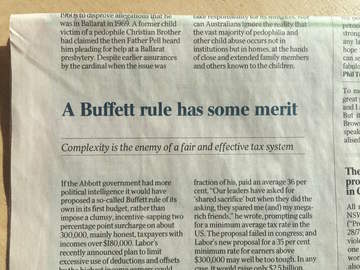
Thanks to you, not only is the Buffett Rule supported by 79% of Australians and not only is it in the Labor Party platform - it's even backed by the Murdoch Press, in an editorial in The Australian.
The next critical step in the campaign is to get the Coalition to come on board - and there's no one they listen to more than the Murdoch Press.
Send a copy of The Australian's editorial backing The Buffett Rule to Coalition MPs and senators.
31 October was the deadline for many people to lodge their tax returns. But for a privileged few, this is the season for pricey accountants to find loopholes and deductions to eliminate their tax bill altogether - just like 55 millionaires did in 2012-13.
The Buffett Rule would put a stop to that, by enforcing a minimum tax rate on the top 1% of income earners, no matter how many loopholes their accountants jump through.
Thanks to you, not only is the Buffett Rule supported by 79% of Australians and not only is it in the Labor Party platform - it's even backed by the Murdoch Press, in an editorial in The Australian.
The next critical step in the campaign is to get the Coalition to come on board - and there's no one they listen to more than the Murdoch Press.
Send a copy of The Australian's editorial backing The Buffett Rule to Coalition MPs and senators.
Thanks to tax loopholes and high priced accountants, Kerry Packer famously reduced his effective tax rate so he paid less tax than his gardener. "The Buffet Rule" would put provide a catch-all for tax loopholes used by high income earners.
The proposed policy would see the wealthiest 1% of Australians, who earn $300,000 or more, pay a minimum of 35 percent tax on their total income – around the top marginal rate for everyday Australians. The rule would only apply to these individuals if through tax deductions they managed to lower their effective tax rate below 35 per cent.
There are sound reasons for some deductions and this rule would not prevent them. It merely places a limit, so that high income earners can't end up paying a lower tax rate than middle income earners.
The rule is named after US billionaire Warren Buffett who was outraged to find his secretary paid a higher rate of tax than he did. So he proposed a minimum effective tax rate to stop the 1% making excessive use of deductions and loopholes.
Click here to see the full policy report on the Buffett Rule, funded by GetUp members and prepared by The Australia Institute based on modelling by the National Centre for Social and Economic Modelling (NATSEM).
The proposed policy would see the wealthiest 1% of Australians, who earn $300,000 or more, pay a minimum of 35 percent tax on their total income – around the top marginal rate for everyday Australians. The rule would only apply to these individuals if through tax deductions they managed to lower their effective tax rate below 35 per cent.
There are sound reasons for some deductions and this rule would not prevent them. It merely places a limit, so that high income earners can't end up paying a lower tax rate than middle income earners.
The rule is named after US billionaire Warren Buffett who was outraged to find his secretary paid a higher rate of tax than he did. So he proposed a minimum effective tax rate to stop the 1% making excessive use of deductions and loopholes.
Click here to see the full policy report on the Buffett Rule, funded by GetUp members and prepared by The Australia Institute based on modelling by the National Centre for Social and Economic Modelling (NATSEM).
Taxation loopholes have long been the domain of the wealthiest Australians due to the huge costs in hiring taxation experts who can play the cat and mouse game of chasing tax loopholes.
According to the Australian Tax Office, 55 Australians who each earned over $1 million in 2012-13 reduced their taxable income to mean they paid no tax.
The Buffett Rule would mean that the load is spread more evenly across all of us at a level that matches up with our income. It would also raise $2.5 billion a year in additional revenue, just by making the existing tax system more effective, which is more than the amount of the Abbott Government's proposed cuts to Newstart benefits and the age pension combined.
Click here to see the full policy report on the Buffett Rule, funded by GetUp members and prepared by The Australia Institute based on modelling by the National Centre for Social and Economic Modelling (NATSEM).
According to the Australian Tax Office, 55 Australians who each earned over $1 million in 2012-13 reduced their taxable income to mean they paid no tax.
The Buffett Rule would mean that the load is spread more evenly across all of us at a level that matches up with our income. It would also raise $2.5 billion a year in additional revenue, just by making the existing tax system more effective, which is more than the amount of the Abbott Government's proposed cuts to Newstart benefits and the age pension combined.
Click here to see the full policy report on the Buffett Rule, funded by GetUp members and prepared by The Australia Institute based on modelling by the National Centre for Social and Economic Modelling (NATSEM).
TELL YOUR FRIENDS!
Copy the link to IM, Skype or post it!
In taking action, I agree to GetUp's Privacy Policy.
Email your Coalition representative
Use the form below to send your Coalition MP or senator a message on the need for a Buffett Rule.Not sure what to say? Feel free to use the talking points and information on the page to start your email.